
Friday 31st
Unfortunately none of the team were available yesterday but warbler migration continues steadily. Twenty-four birds were ringed today. Warblers formed the bulk of this led by six Willow Warblers and four Whitethroats. There were two each of Sedge Warbler, Blackcap and Chiffchaff plus a Lesser Whitethroat. Resident birds continue to appear , including juvenile Blue Tit, Dunnock, Goldfinch, Robin, Wren and Great Spotted Woodpecker.
Wednesday 29th
Hot, dry and very little breeze combined to give a good mornings ringing. Forty two birds were ringed helped by the first arrival of Willow Warblers, of which 15 were ringed. Whitthroats numbered six and there was five each of Reed and Sedge Warbler.other warblers included two Lesser Whitethroats, a Garden Warbler and a Chiffchaff.
Monday 27th
Not as breezy as yesterday but still noticeable, it remained hot and dry. Thirteen birds were ringed including the first Lesser Whitethroat of the autumn. The other birds were two Sand Martins, three Willow Warblers, three Whitethroats (one of which was an adult which was not far from completing its post-breeding moult), two Blackcaps, and two Great Tits.
Sunday 26th
The wind put an early end to activities today but there was still no rain.
The six birds ringed were singles of Chiffchaff, Great Tit, Sand Martin, Sedge Warbler, Willow warbler and Wren
Saturday 25th
Similar conditions to yesterday but breezier and hotter later. Another interesting morning with two more species caught up with for the year - Sand Martin and Garden Warbler. There were also four Great Tits, three each of Blackcap, Reed Warbler and Robin, two each of Blue Tit and Whitethroat plus a Wren.
Lots of the juveniles are still in full juvenile plumage but there is a noticeable increase in birds starting post-juvenile moult as we would expect.
Friday 24th
A bit of breeze at first but that did not persist, the rest of the day remained hot and dry. Nineteen birds were ringed. This included the first Treecreeper for a couple of years, two Green Woodpeckers, three Reed warblers and five Robins.
Thursday 23rd
Today started clear but with no breeze. Although what we hoped was threatening cloud developed there was no rain and the drought continues. There were 14 new birds this morning. This included the first Willow Warbler and Sedge Warbler of the autumn. Reed Warblers appear to be on the move early and another five were ringed.
Wednesday 22nd
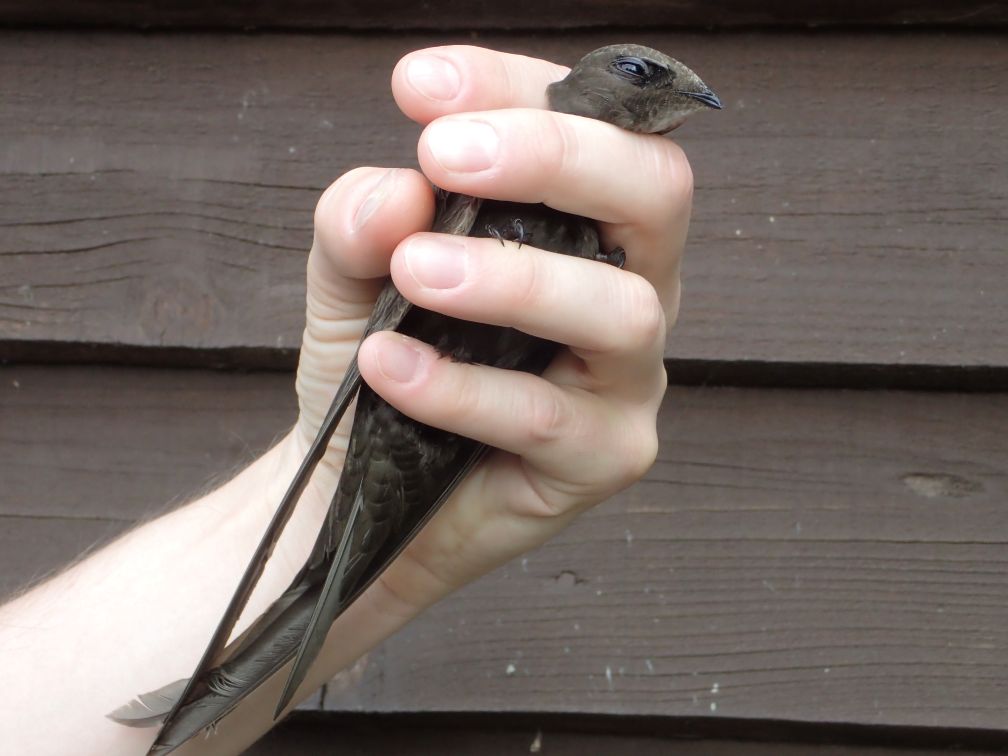
The wind dropped and it was overcast creating good conditions for ringing. Twenty two birds were ringed with the highlights being the first Swift since 2018 and a Wood Warbler. The supporting cast were six Whitethroats, three Blackcaps, three Reed Warblers, two Robins, two Blackbirds and singles of Chaffinch, Dunnock, Great Tit and Wren.
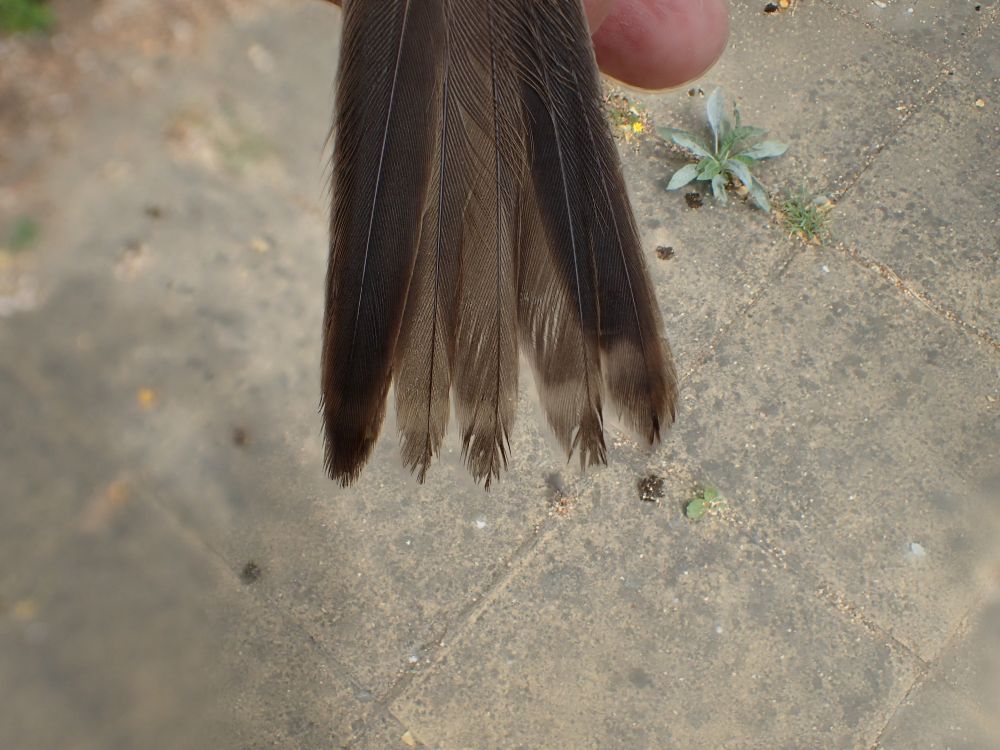
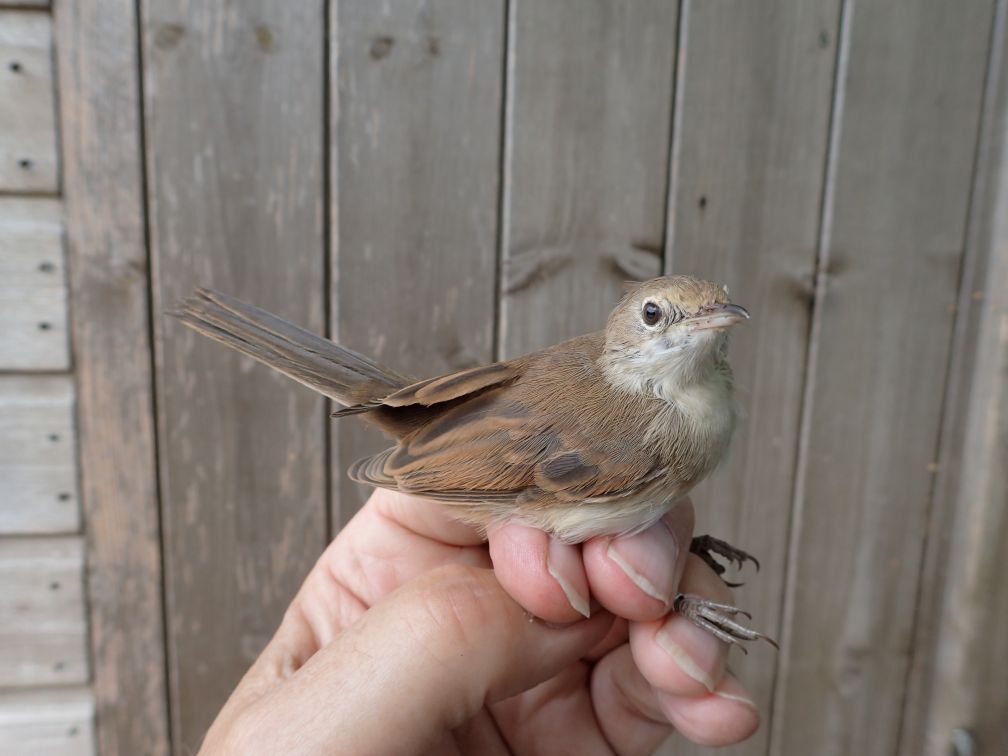
One of the difficulties as a nestling is that you are totally reliant on what food the parents can find. Periods of poor weather resulting in a shortage of insect prey will affect the quality of the feather growth. This can show as what are known as fault bars- areas of lower quality feather. Some of the warblers we are seeing are showing particularly obvious ones this year. The Whitethroat below shows this clearly in its tail, the rest of the feathers appear unaffected.
Monday 20th
The northerly did not relent and so the use of nets was restricted. There were still 16 new birds. Linnet was the first for a couple of years. Young Blackcaps continue to appear with four more plus four more Reed Warblers. One of these might have been a genuine migrant as it had a high fat score of 5.
Sunday 19th
Despite the continuing northerly, and because of it in the case of the Swallows, it was a good session. Twenty-eight birds were ringed of 11 species. Green Woodpecker was new for the year. Most of the rest were products of what is proving to be a good breeding season. Four Reed Warblers and three Swallows were the best and five Chaffinches notable.
Friday 17th
The weather ignored the forecast and started cloudy with the northerly breeze still hanging on. This was great for us as we had planned to do work in the heligoland and main ringing area to remove overhanging vegetation. This we did successfully without being fried.
There was a bit of ringing activity. First of all a juvenile Jackdaw was retrapped. Of note was how thin it was, the drought is making it very hard for them to find grubs and will probably thin out the population.
Secondly a Pied Wagtail chased a moth into the Moffice and so was caught. This is the first for at least a couple of years.
Wednesday 15th
The wind has prevented meaningful netting but today relented enough to allow checking of House Martin and House Sparrow nests.
Both are busy playing catch up and there are nests with new eggs. The House Martins are also playing around. For instance one nest, which has not been used yet, had two juveniles in but they were both from different nests. Another previously unoccupied nest had a new clutch of eggs.
Sunday 12th
It was not the heat but a strong north-easterly which limited what could be done. There were still 14 birds ringed - Blackcap 4, Robin 2, plus singles of Blue Tit, Chiffchaff, Dunnock, Great Tit, Reed Warbler, Swallow, Wren and Jackdaw.
The Swallow is only the second this year. Blackcaps seem to be having a successful breeding season with another brood. The Jackdaw was a bonus as the farmer has moved the cattle and so there are not lots of corvids feeding nearby.
Friday 10th
With care it was possible to do some ringing but the heat has to be watched. There were 18 new birds, mostly more fledglings - Great Tit 5, Blackcap 4, Dunnock 2, Whitethroat 2, plus singles of Wren, Reed Warbler, Chiffchaff, Robin and Blackbird.
Tuesday 7th
The day started warm and just got more humid and hotter. This meant the small groups of hirundines soon disappeared as they followed the insects high into the sky.
The only new birds to be ringed were two juvenile Blackcaps and a juvenile Whitethroat.
Saturday 4th
A quiet morning with the heat building up. A flock of 40 Sand Martins showed some interest but their food was flying much higher and they were more interested in that. Singles of juvenile Blackcap, Dunnock, Reed Warbler, Whitethroat and seven nestling House Sparrows were ringed.
Friday 3rd
The first session this month continued the pattern with a few fledged warblers and some corvids. There were 11 new birds; four Chiffchaffs, two Blackbirds, two Jackdaws and singles of Whitethroat, Blackcap and Blue Tit.
Wednesday 1st
A check of the nest boxes in The Elms showed some success with tit broods that were being incubated during the cold snap in May plus those which were a bit more advanced surviving the cold. A couple of nets had failed and looking at the size of the chicks it was probably during the cold spell.
There was one surprise along Guilford Road where a nest of Great Tits were ringed and would probably be another seven days before fledging. The parents were possibly having a replacement brood having failed early on in the season.
June summary
One hundred and ninety-seven birds were ringed and there were 113 subsequent encounters.
With nearly all the nest box tit pulli being ringed by the end of May (114 Blue, 74 Great and nine Coal) we concentrated on The House Martins (28 so far) and House Sparrows (35 this month). The House Martin number is well down so far but they seem to be enjoying the current weather and are trying to catch up.
Blackcaps are showing good productivity with 24 fledglings ringed so far as are Whitethroats with 15. A juvenile Cetti's Warbler reflected the strong showing of this species in the nearby areas.
The Crow Trap finally lived up ton its name and 21 Jackdaws, three Rooks, two Crows, two Magpies and a retrap Jay have been caught. Of the three retrap Jackdaws, one of was at least eleven years old.