
Friday 31st
Trapping continued in my absence but I am told it was fairly quiet. This is not a surprise as the moon is very bright. Last night the temperature did not drop below 17.4°C but the catch was still limited to 223 moths of 78 species- as light improvement on the previous night.
Small Mottled Willow maintained its top spot with 14 and there were three Gypsy Moths and two Silver Ys. The best record was of three Cydia amplanas.
Monday 27th
The thermometer said it was a minimum of 15.3°C but it felt much warmer. There were 456 moths of 92 species. The Oak Processionaries had mostly moved on and there were just two. Small Mottled Willows continued their impressive numbers with another 36. There was also a Scarce Bordered Straw and a Vestal. Local specialities included three Rest Harrows and a Rosy Wave. Another sign of the approaching end of summer (!) was the first Square Spot Rustic.
Sunday 26th
Up another degree to a minimum of 16.6°C. The number of individuals went up to 433 but there was one less species - 97.
Migrants put in a strong showing and 25 Oak Processionaries was a record for one night. Small Mottled Willow reached 38, there were 25 Silver Y's, two each of Yponomeuta rorella and Gypsy Moth, plus a Cydia amplana. Thankfully there was no further invasion of ground beetles.
Saturday 25th
It continues to warm up, this time the minimum was 15.4°C. There were 352 moths of 98 species. In the macros Common Rustic agg. was most numerous with 35. Buttoned Snout was new for the year. Migrants continue to appear in good numbers. They included 16 Small Mottled Willows, Four Rush veneers, three Bordered Straws, a Scarce Bordered Straw, and two each of Dark Sword-grass and Oak Processionary.
Although they did not attack the moths the underneaths of the egg boxes held over 1,200 ground beetles and their movement did not help the moths settle.
Friday 24th
The nights are warming up again and so the number of moths is creeping up. Last night there were 292 moths of 83 species. Oak Processionary and Small Rufous were new for the year. Small Mottled Willow was the most numerous with 37. Other migrants included seven Silver Ys, two Diamondbacks and a Dark Sword-grass. Also of interest was a Dingy Footman of the buff coloured form stramineola and very smart Bordered Pug.
Thursday 23rd
The wind dropped but the sky cleared and it was cooler at 10.8°C. the number of moths reduced to 104 but the number of species increased to 50. Silver Ys outnumbered Small Mottled Willows for the first time seven to four. There was also a Gypsy Moth and a Bordered Straw.
Wednesday 22nd
The nights are still cool due to the breeze. There were just 115 moths of 42 species. Migrants included ten Small Mottled Willows, six Silver Ys and a Rush Veneer. We recorded our second ever record of Nemapogon clematella. A female Oak Eggar was the first for this year.
Saturday 18th
The northerly is slowly abating and with complete cloud cover the temperature did not fall below 16°C.
Although the count was very similar - 285 - the variety was greater with 90 species. Diamondback was down to 15. Other migrants were Small Mottled Willow - 13, Silver Y - three, Rusty-dot Pearl - two, and singles of Scarce Bordered Straw, Bordered Straw, Dark Sword-grass and best of all the tortrix Cydia amplana.
Yellow-tail and Wormwood Pug were the first of this year.
Friday 17th
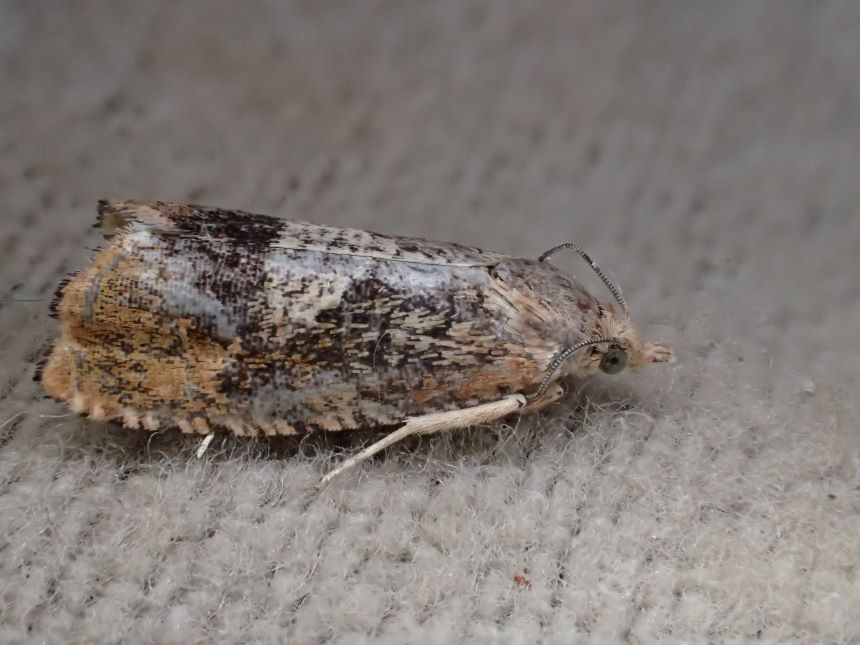
Due to a mixture of strong northerly and people being a way the trap was not run until last night. The effects of the persistent northerly and the drought were shown by the trap having 'just' 289 moths of 62 species despite a minimum of 15°C. A Painted Lady was unexpected, we get Red Admirals annually but not Painted Ladies.
Diamondback was top with 78 individuals followed by 50 Uncertains. The run of Sciota rhenellas kept going with another two. There were also seven Small Mottled Willows, three Rusty-dot Pearls and a Silver Y.
Hummingbird Hawk-moths were more obvious on suitable nectar sources.
Monday 13th
Some late news in. An Elachista species caught on 13th June has been confirmed as E.scirpi. A new species for Sandwich Bay and only the third for Kent, first since 1990.
Friday 10th
There was a slight bump in numbers to 305 moths of 82 species from the main car park trap. It was a good night for migrants - a Tree Lichen Beauty, a Dewick's Plusia, eight Small Mottled Willows and 18 Silver Y. A Sussex Emerald and a Festoon were also present.
Portable traps performed very well - an LED in Restharrow Dunes brought 163 moths of 46. Three Pempelia genistella were good records and there was a Rosy Rustic and a Vestal. Two LEDs in Jubilee Field had a Magpie and a Scorched Carpet among 108 moths of 43 species. In the Dragonfly Pools, another LED managed 96 moths of 46 species. While there were no new species for the year, a Coxcomb Prominent was a good catch. An LED and Actinic in Middle Field had 133 moths of 63 species. A putative COAST DART was the clear highlight and would be a long overdue first for the Recording Area if proven, however gen det analysis would be needed to separate from the common and incredibly variable White-line Dart.
Thursday 8th
An MV in The Elms had a bumper catch of 534 moths of 126 species - 163 of which being Mother of Pearl. Scanning through the M.O.P horde had a few species scarcely seen in the HQ trap - two Lesser-spotted Pinions, a Small Scallop, Yponomeuta plumbella, Dioryctria abietella, Acrocercops brongniardella and Caryocolum marmorea to name a few. There were also two Dark Umbers, three Promalactis procerella, seven Lunar-spotted Pinions, and our 2nd Blastobasis rebeli this week. A Norfolk Hawker was strangely also present
Four portable traps were spread around the Gullies - two LEDs in Waldershare Gully had a late record of a brunnea-type Lime Hawk-moth, a Waved Umber, and another misplaced Migrant Hawker. In Big Gully was the fourth Promalactis procerella of the day, two Oxypteryx wilkella, a Jersey Tiger, and Small Wainscot. In Little Gully were 48 moths of 24 species.
Wednesday 8th
I guess it would be boring if we could predict what might happen in the trap. Last night was warmer (16.2°C) and very humid. Despite these apparently good conditions the catch fell to 201 moths of 85 species.
There were only a few migrants - six Small Mottled Willows, four Silver Ys and a Rusty-dot Pearl. There were no Diamond-backs for instance.
The micro Prays fraxinella is not an annual visitor.
Tuesday 7th
It was humid again last night and it a bit warmer. Despite this there were a few less moths, with 303 of 107 species in the main trap. Highlights here included two more Splendid Brocades and an Ethmia quadrilella. Migrants included ten Small Mottled Willows, five Silver Y's, and a Rush Veneer. Two Brown-veined Wainscots and an Anania perlucidalis were new for the year.
A trap by the feeders caught a Light Crimson Underwing and a portable trap by the Whitehouse caught the second record of Musotima nitidalis. This lives up to one of its given English names of Golden-brown Fern. Unfortunately it escaped before being photographed. Late in the day a Currant Clearwing came to lure, only our second record and first since 2019.
Monday 6th
It was a bit cooler at 13.5°C overnight but still very humid. Although the catch was down to 376 moths there were still 115 species of a fascinating variety.
New for this year were Shoulder-striped Wainscot, Jersey Tiger, Olive, Small Blood-vein, and Plain Pug. There was also another Sciota rhenella plus an Acrobasis tumidana, both species once considered very rare.
A visitor trapped by the feeders and one of the highlights was a Promalactis procerella. This has been given the English name Beautiful Silver-mark and it lives up to that name.
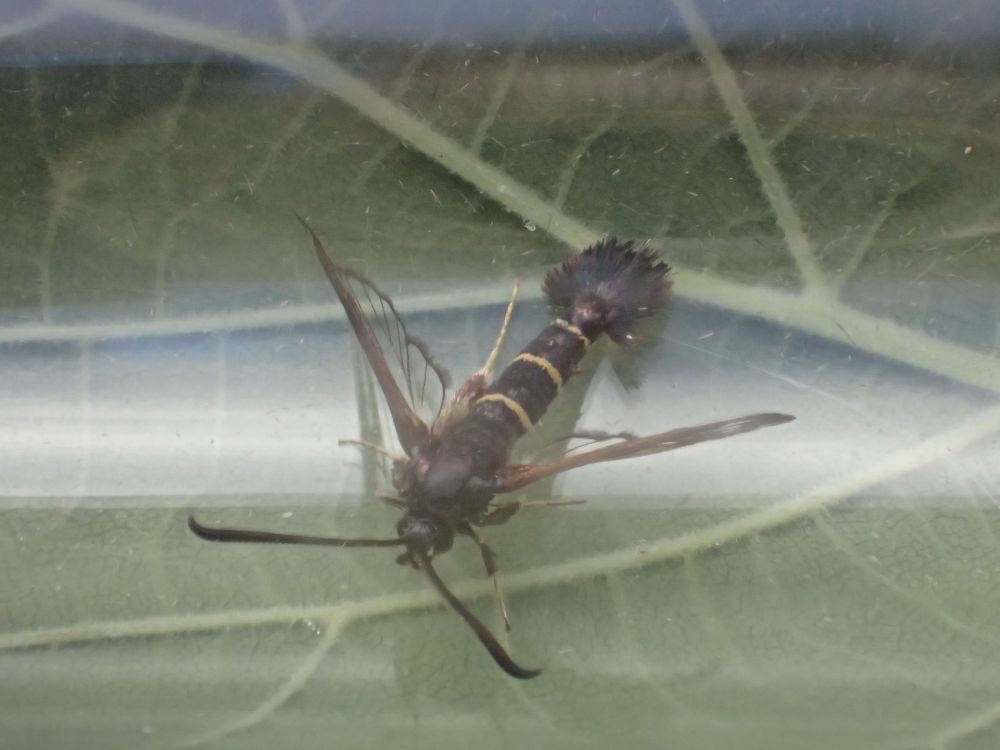
All this was eclipsed later in the day when visitors staying at the Observatory recorded our first ever record of Sallow Clearwing to a lure - well done Mark and Lynnette.
Sunday 5th
The temperature did not fall below 15.6°C and it was humid. This provided excellent conditions, in fact the best this year. The car park trap alone held 568 moths of 132 species. Visitors spread themselves around the area and the final species total will be more than 300.
Highlights in the car park included another Splendid Brocade and Sciota rhenella. Archer's Dart was new for the year and the second generation of Nut-tree Tussock emerged. We had our third ever record of Caloptilia honoratella. Small Mottled Willows continued to outnumber Silver Y's this time 12 to 2. There were 13 Diamondbacks and Pearly Underwing.
The macros Small Marbled and Suspected were added by the visitors and we have more than one micro which maybe new for our area, but they need genital determination.
Saturday 4th
The temperature went down to 12.6°C and the sky was clear. There were 260 moths of 66 species. Dusky Sallow and Least Carpet were new for the year as was the 5th ever record of Acleris holmiana. Migrants included another Sciota rhenella, nine Small Mottled Willows, eight Diamondbacks, three Silver Ys, two Dark Sword-grasses, and a Rusty-dot Pearl.
A visitors trap caught the second Sussex Emerald of the year.
Friday 3rd
Last night was slightly cooler at 12°c. This reduced the catch to 199 moths of 70 species. There were still some migrants including another Splendid Brocade, 11 Small Mottled Willows, four Silver Ys, and two Rusty-dot Pearls. There were no Diamond backs. The attractive local Cynaedia dentalis was of note.
Thursday 2nd
Last night was warmer at 14.9°C. This helped increase the catch to 332 moths of 75 species.
After a steady trickle of Lesser Broad-bordered Yellow Underwings, Langmaid's Yellow Underwing got going with three recorded. There were some migrants namely 20 Small Mottled Willows,17 Diamondbacks, three Silver Ys, and singles of Splendid Brocade, Pearly Underwing, Dark Sword-grass, and Scarce Bordered Straw.
There was another Silver Barred and Lunar-spotted Pinion continued their good year with another example.