
Monday 31st
No ringing today due to the strength of the wind. It is interesting to compare August 2026 with August 2025.
Amazingly we ringed the same number of birds in each - 668.
Individual species totals showed more variation, particularly amongst the warblers. Blackcap increased from 120 to 141 but most others showed a decrease e.g. Willow Warbler 73, down from 108, Garden Warbler nine, down from 29 and Lesser Whitethroat 11, down from 22. House Sparrow increased from four to 20 and Robin from 20 to 43.
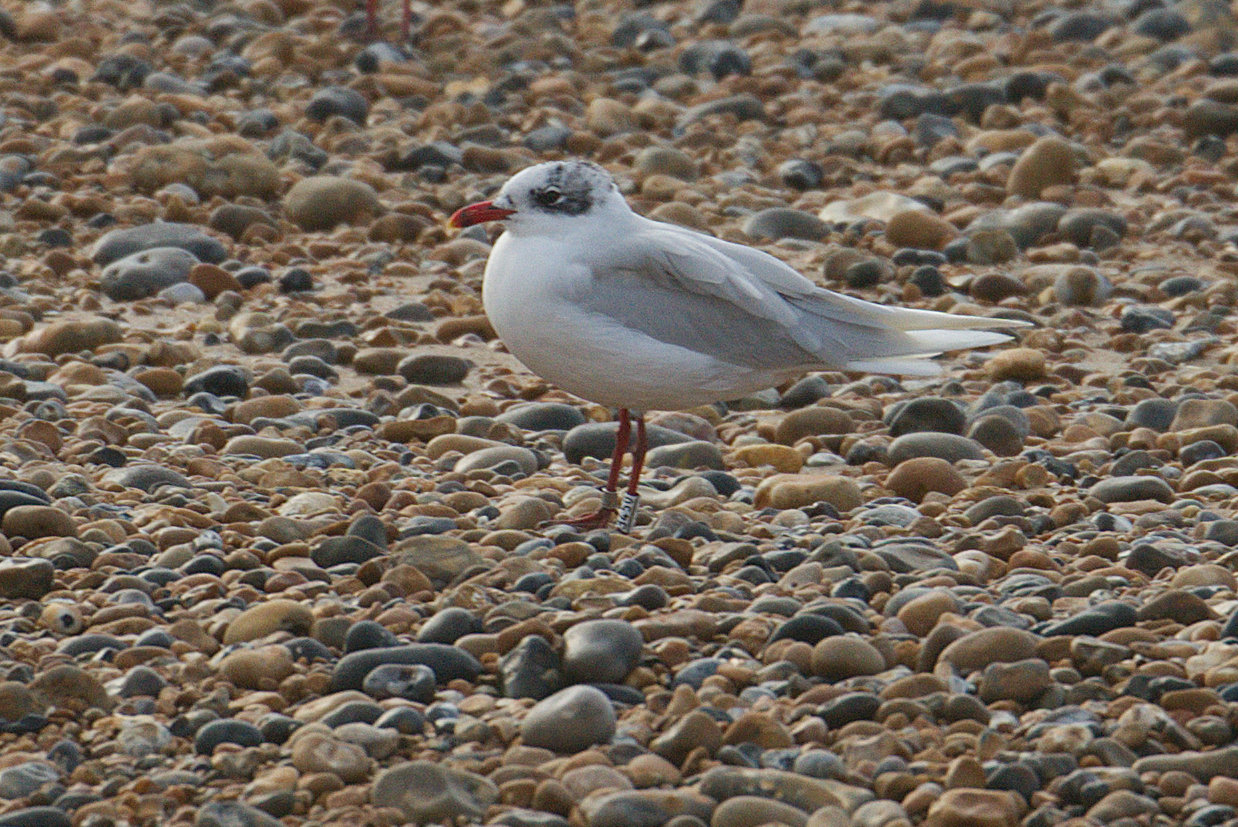
We continue to get colour ring sightings and there have been two more of late. As there are 2000+ Mediterranean Gulls present in the Bay at times it is well worth watching to see if they come close enough to view.
The latest two were seen on July 31st. Both were ringed as pullus. One from Antwerp had been ringed on June 18th 2020. It has also been seen at Pas de Calais, Malaga, Birchington, New Romney and Copt Point. The second was ringed in North Holland on June 25th, 2021. Since then it has been noted at Pays de la Loire and Pas de Calais.
Sunday 30th
Fortunately the overnight wind dropped enough for sheltered nets to be used. It remained warm and dry.
For the second day running Willow Warbler was the most numerous but only with seven birds. Blackcap equalled this. There were also two Reed Warblers and singles of Blue Tit and Chaffinch.
Saturday 29th
Although the wind rattled branches hard overnight it drooped for a while this morning allowing some ringing before the forecast squally rain arrived mid-morning.
Twenty one birds were led by eight Willow Warblers and five Blackcaps. Pied Flycatchers continued their good (for these days) autumn with another two. One of these was an adult male which was a surprise, I do not remember one in the autumn here. There was also the first Spotted Flycatcher of the autumn. The supporting cast were two each of Chiffchaff and Robin plus a Reed Warbler.
Friday 28th
Suitable conditions in the morning resulted in 29 birds being ringed. Blackcaps made a good appearance with 18 ringed and Reed Bunting was new for the year.
Thursday 27th
A real rarity this morning - we could not ring due to it raining! Unlike other parts of the UK there was no overnight rain but it did rain steadily for a couple of hours this morning.
There is more news on movements;
A Blackcap we ringed as a juvenile in early July was caught at Dungeness on August 23rd. We regularly exchange birds with nearby sites along the coast. Some birds seem to stop at the coast and move up and down it for a while.
Two more colour ringed Mediterranean Gulls were observed on the shoreline. One had been ringed as a pullus at Antwerp on June 18th 2020. Since then it had moved around the Channel coast, being observed at Pas de Calais, Malaga in Spain, Birchington, New Romney and Copt Point. The other had been ringed as a pullus in North Holland on June 25th 2021, and subsequently at Pas de Calais and Pays de la Loire.
Wednesday 26th
The wind finally changed to a gentle south-easterly and it became hot and humid. Eighteen birds were ringed today. Blackcap is trying to make up for the lack of other birds with another nine. There were three Chiffchaffs, two each of Willow Warbler and Great Tit, plus single Robin and Whitethroat.
Although the number of birds is greatly reduced the condition of the birds we are catching does not show any reason for concern.
Monday 24th
No ringing today but we have had confirmation of the Wood Sandpiper colour ring already. It was ringed as a bird of the year on passage at Revlangen in Norway nine days ago on 13th August. The site is 874 km to the north.
Sunday 23rd
The wind dropped as forecast and it was a better day with 61 birds ringed. Blackcap is already building up a head of steam and 23 were ringed. Next was Reed Warbler with nine then seven Willow Warblers and Robin with six. There were three each of Dunnock, Lesser Whitethroat, Sedge Warbler and Whitethroat, two Blue Tits and singles of Greenfinch and Sparrowhawk. There is an unsettled spell of weather approaching and so it is nice to do days like this.
Saturday 22nd
The lack of migrants is becoming worrying. Ten birds were ringed today - seven Blackcaps, and singles of Lesser Whitethroat, Robin and Reed Warbler. So far this month we have ringed 48 Willow Warblers, this is less than half the number last August which we considered a poor total. Lets hope there is a recovery in the remaining few days.
A colour-ringed Wood Sandpiper observed on Backsand Scrape has been traced back to a Norwegian project and we await the details with interest.
Friday 21st
The stiff breezes and unsettled weather seems to be affecting migration which continues just as a dribble.
We have had details on a number of colour ring sightings from the spring. The first three involve Great Black-backed Gulls observed on Restharrow Scrape. Two had been ringed as pulli in Norway. The first was ringed at Ringholmane on July 7th 2023. It was seen in Northern France the same year and then recorded here between May 8th and 17th this year. We are 1245km south of the nest site. The second was ringed at Sletthomen on July 1st 2024. It was seen at Dungeness in February and March 2025 and here on May 2026. The third bird was ringed at Graesholm in Denmark as a chick on July 1st 2025. It was seen on the Scrape on May 12th until June 8th.
Wednesday 19th
After such a long period of dry it is almost a pleasure to report the start of ringing was delayed by some light rain. Although we need plenty it is good that it is not torrential rain with its associated problems for the birds. Birds again chose not to move overnight. There were nine new birds before some more approaching showers ended proceedings. The new birds were a Blue Tit, a Lesser Whitethroat, two each of Blackcap and Willow Warbler plus three Reed Warblers.
Once again the hirundines chose to be busy feeding well above net height.
A big thank you to the visitors who took the time to check a dead Cormorant on the beach and bring the metal ring and colour ring into us. The bird is part of a study in Holland.
Tuesday 18th
Sometimes a shower of rain just before dawn might cause an arrival of migrants but not usually when the wind was from the west. The bushes were very quiet and just eight birds were ringed. These were a Garden Warbler, a Song Thrush, three Whitethroats, two Willow Warblers and a Wren.
The breeze increased quickly ending proceedings.
Sunday 16th
Another warm and muggy day, but this time with only a gentle breeze. Sixty-two birds were ringed. Probably for the first time for some years Sedge Warbler was most numerous with 14, closely followed by Reed Warbler with 12 and Willow Warbler with 11. The supporting cast was seven Blackcaps, four Robins, three Pied Flycatchers, two each of Dunnock, Wren and Whitethroat and single Great Spotted Woodpecker and Swallow.
Most of the Reed Warblers continue to show high fat scores of between four and six.
Saturday 15th
With an overnight minimum of 18.4°C it was a warm and muggy start to the second day of the ringing weekend. There were slightly less birds with 85 being ringed but the variety was good. Redstart, Grasshopper Warbler and Sparrowhawk were new for the year. Reed Warbler was again most numerous with 21, followed by 17 Blackcaps and eleven Sedge Warblers. After none yesterday there were four Garden Warblers today. There were also eight Willow Warblers, four each of Whitethroat and Robin, three each of Blue Tit and Dunnock, two each of Blackbird, Chaffinch and Goldfinch, plus a Great Tit.
Many of the Reed Warblers had high fat scores of five or six and seem to be well stocked up for the flight south.
Friday 14th
The first morning of our ringing weekend dawned warm and calm. The temperature continued to rise and we were packing up by mid-morning as it approached the mid-thirties. One-hundred-and-thirteen birds were ringed. Reed Warbler led the way with 37 followed by 17 each of Blackcap and Whitethroat. There were seven Robins, four House Sparrows, three Lesser Whitethroats, two each of Blue Tit, Chaffinch, Chiffchaff, Willow Warbler and Wren plus single Dunnock, Great Spotted Woodpecker, Great Tit and Green Woodpecker. The bonus catch was a Kingfisher and two Pied Flycatchers.
One of the juvenile Bullfinches caught in the Whitehouse had made its way to the Gullies at the south end of the Estate. We have not caught any birds this autumn which had been ringed elsewhere.
Thursday 13th
The wind dropped and there were some new arrivals before a temperature in the mid-30's stopped avian and human activity.
Thirty-one birds were ringed. These were seven Blackcaps, four each of Blue Tit, Chiffchaff, and Willow Warbler, two each of Reed Warbler and Robin and singles of Great Spotted Woodpecker, Great Tit, Lesser Whitethroat, Whitethroat, Sand Martin and Wren. The surprise of the morning was two juvenile Bullfinches.
Tuesday 11th
The easterly was fresher than expected and so netting was limited. In a short session six birds were ringed - House Sparrow, Chaffinch, Goldfinch, Willow Warbler, Reed Warbler and the first Pied Flycatcher of the autumn.
Sunday 9th
The team were up early enough to get a surprise when there was a minutes worth of rain drops. Twenty-two birds were ringed. There were three each of Blackcap, Great Tit, Reed Warbler, Whitethroat and Willow Warbler, two Sand Martins and singles of Blue Tit, Chiffchaff, Garden Warbler and Sedge Warbler. A Meadow Pipit was a big surprise in the bushes area.
Saturday 8th
It continues hot and dry. With clear skies there are only small numbers of migrants stopping off. Eighteen birds were ringed. Willow Warblers remain thin on the ground with just one caught. Reed Warbler (6) and Whitethroat (5) keep up their steady trickle. There were also singles of Blackcap, Chaffinch, Chiffchaff and Sand Martin.
Friday 7th
With ringer available the nets were back up and there was a steady trickle of new birds in the usual hot, dry conditions. Thirty were ringed; Reed Warbler eight, Blackcap five, Whitethroat four, two each of Willow Warbler and Chiffchaff, plus singles of Chaffinch, Great Spotted Woodpecker and Wren.
Yesterday evening a juvenile Herring Gull wandered into the Observatory lobby and so became the first one to be ringed here for more than ten years.
Thursday 6th
The House Martin nests were checked today with the thought it might be one of the last checks this year but this will not be the case. In a burst of activity there are five nests with eggs. If successful they will not be fledging until September. It will however make up foe the slow start.
Wednesday 5th
It started breezy and picked up and so by 8am we were packing up. Just four birds were caught, all new, namely two Whitethroats, one Reed Warbler and a Sand Martin.
An hour after we stopped a big rarity arrived - there were five minutes of strong rain. It was enough to create a puddle but this quickly evaporated in the sun and breeze.
A colour-ringed Herring Gull recorded on Restharrow Scrape, where it was feeding fledged young, had been ringed in Essex in March 2015 and subsequently recorded at Silvertown, London in early 2017 before moving to Sandwich by May 2017.
Tuesday 4th
Hot and reasonably calm this morning. Twenty two birds were ringed plus 6 pulli House Sparrows. The ringed birds were five Whitethroats, four Reed Warblers, two each of Blackbird and Blackbird, plus singles of Blue Tit, Dunnock, Garden Warbler, Great Tit, Sand Martin and Sedge Warbler. All birds were juveniles.
Monday 3rd
Despite the clear sky overnight it definitely was not a cool start. There were just nine new birds - three each of Willow Warbler and Reed Warbler, plus singles of Whitethroat, Sand Martin and Chaffinch.
Sunday 2nd
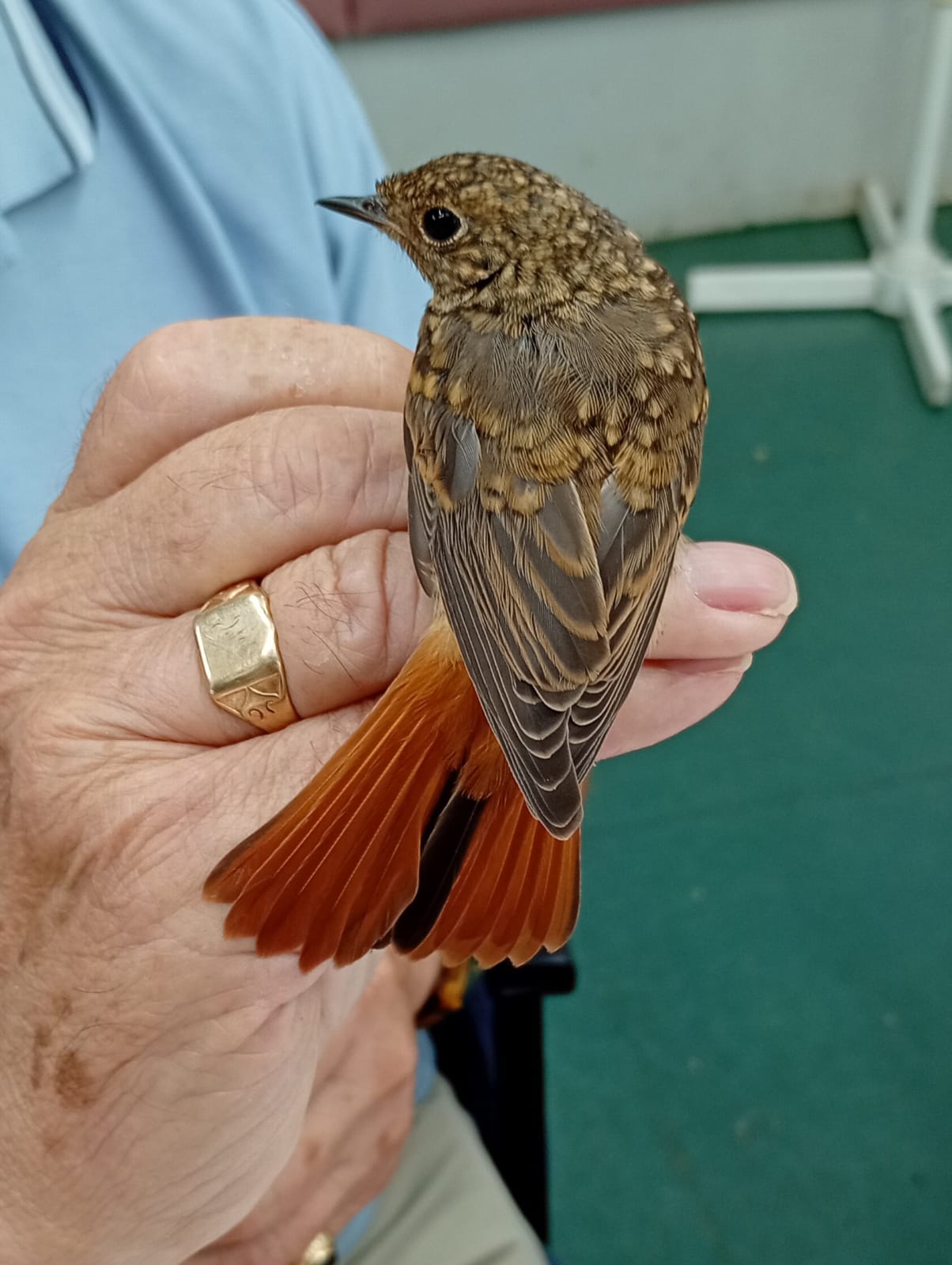
A surprisingly cool start, due to the clear sky probably, but it soon got hot. A young Redstart was ringed.
Saturday 1st
A hot dry morning which was finished with a very rare sighting. There was a tiny amount of rain - enough to darken the paving slabs, but no more.
Twenty-six birds were ringed. Reed Warbler continued to do well with nine new birds and two subsequent encounters. Other warblers included four Willow Warblers and two Whitethroats.
With the approach of some dark clouds we hoped we might catch some hirundines but the air, with its accompanying insects, rose followed by the hirundines.