
I was born in May 1937 in Ashford Kent. In the closing days of WW2 my family moved to Margate and I had the good fortune to find that one of our close neighbours was interested in Natural History. We, George Dunkling and I, started by collecting tadpoles and sticklebacks from the local Tivoli Brook. Rationing meant it was impossible to purchase a cycle, but we learnt to ride and make bicycles, from scrap. This opened up the world, Minster marshes and Pegwell Bay became our favourite destinations. The latter was being used as the local landfill site.
1953 was a seismic year. My father had died and unbeknown to me my mother was struggling to make ends meet which meant I had to seek employment. Saying goodbye to Chatham House Grammar I joined British Rail and thus began 44 years of working through the ranks. In time I became a mainline Train Driver and eventually a manager. I should add that railways and cricket along with natural history were always the subjects that shared my waking hours.
1953 saw the East Coast floods and our first meeting with Dennis Harle. This was a brief shouted conversation across the Stour, “who are you what have you seen”. In August of that year as George & I cycled along Strand Street, Sandwich a man came out of his house jumped on his bike, looked back & stopped. “I know you two, would you like to come down to Sandwich Bay we might catch a few birds”. Curiosity, catch birds, Sandwich Bay, the Garden Heligoland trap? While sitting on the dunes waiting for something to happen, Dennis began to quiz us, “Do you know that bird? What about that plant?’, etc. The first drive on the trap produced a Lesser Whitethroat. Once ringed and measured we were allowed to hold the bird in the hand.
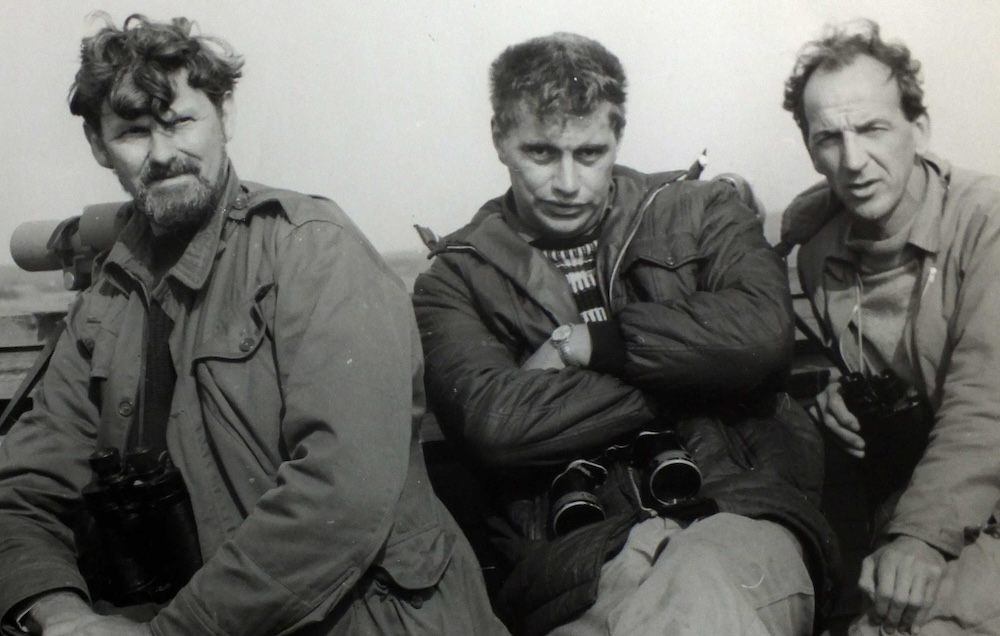
John (centre) with Dennis Harle (left) and Dennis Batchelor (right) on a birding trip to Sweden in 1967 - both stalwarts of the Bay from the 1950's onwards
I had entered the world of bird migration. Everything was new. The multi-volume ‘Handbook of British Birds’ was the only reference book, rings came in small packages and had to be threaded on to needles for safe-keeping. The first Japanese Mist Nets had not reached the UK and Ringing Pliers were still at the trial stage and we had no shelter from the elements.
Two years of National Service interrupted my involvement at the Bay. Postings to Korea and Gibraltar gave me only frustrating glimpses at the natural world. Golden Orioles calling as they migrated northwards over the war-torn peninsula and on the ‘Rock’ I witnessed an autumn `fall` of Redstarts and Flycatchers. Oh, for a pair of binoculars!
On my return in early `58 it was good to find that like-minded people had begun to join us. Our first accommodation came in the shape of an abandoned pantechnicon quickly fitted out with a door and a window followed a year or so later with the bungalow. All of this progress eventually led to an invitation to attend the Bird Observatories Conference at Oxford. To meet & listen to the titans of ornithology such as Ken Williamson, David Lack, and Ronald Lockley, which was awe inspiring.
After twenty years my priorities changed knowing that the Observatory was in safe hands. I moved on to a new challenge, raising monies and building facilities for young people who wanted to play cricket. Taking early retirement, I returned to the Bay in the mid-`90`s and worked with Dennis Batchelor among others on collecting data for the proposed Atlas of British Butterflies. How many tetrads we tramped over in TQ & TR and how many pub lunches we enjoyed I shudder to think. The Great Kent Bird Challenge, annual May Day trips to Northern France, Holland for the winter geese. Great days.
A further diversion – military history – Could I help to photograph the graves of the 13,000 members of the Machine Gun Corps who perished in France & Belgium during WW1 ? My wife & I, together with a few friends, managed nearly 6,000, the vast majority on 35mm prints and only a basic TomTom SatNav.
Time to purchase a TV and watch some cricket and rugby.